
I still remember the exact moment.
My wife was six months pregnant with our second kid. It was almost midnight, I was scrolling on my phone while she slept, and I stumbled across the number. $310,000. The estimated cost of raising a child to age 18.
I stared at the ceiling for an hour.
We weren’t broke. We made decent money. But that number made me feel like I was already failing. Like we’d never save another dime. Like we’d somehow made a terrible mistake by wanting a second child.
If you’ve found this article because you’re feeling something similar, take a breath. You’re in the right place.
Here’s what I know now that I didn’t know that night: That $310,000 figure is real, but it’s also deeply misleading. It doesn’t come at you all at once. It’s not a bill that shows up in the mail. And most importantly, there are so many ways to bring that number down without your kid missing out on anything that matters.
I’m writing this because I wish someone had handed it to me back then. A real breakdown from a dad who’s been through it. Not a sterile financial report that makes you feel worse. So let’s walk through the actual numbers, the hidden costs nobody warns you about, and 12 specific things you can do to save your family $5,000 or more this year.
The $310K Reality Check: What That Number Actually Means
Let’s get the headline out of the way first.
According to SmartAsset’s 2025 analysis, which pulls its data from MIT’s Living Wage Calculator, a family of four with two working adults will spend approximately $310,000 to raise a child from birth to age 18.
That’s the number that makes headlines and keeps new parents awake at night.
But here’s the reframe that changed everything for me: That works out to roughly $17,200 per year, or about $1,400 per month. Suddenly, it’s not a life sentence. It’s a monthly budgeting conversation. And once you see it that way, it becomes something you can actually manage.
What the $310K includes: Housing, childcare, food, healthcare, transportation, clothing, and miscellaneous expenses like activities and school supplies.
What it doesn’t include: College costs, the income lost during unpaid parental leave, or the concentrated “startup costs” of baby gear in year one.
It’s also a national average, which means it’s nearly useless for your specific situation. In Mississippi, the annual cost is closer to $19,000. In Massachusetts, it’s over $44,000. Where you live changes the math dramatically. The 2025 figure also reflects continued increases from prior years, driven largely by childcare cost inflation and housing market pressure—two expenses that have outpaced general inflation for years.
Here’s what the data doesn’t tell you: You won’t feel this as a lump sum. You’ll feel it in the grocery bill that somehow jumped $40 this week. The co-pay at the urgent care when your kid spikes a fever at 2 a.m. The daycare payment that hits your account like a second mortgage every month. It’s a thousand small financial paper cuts, not one giant wound. And once you understand that, you can start defending against them.
Where the Money Actually Goes: A Real-World Breakdown
Before you can save money, you need to see where it’s flowing. These percentages are based on SmartAsset’s 2025 analysis of MIT data. Your breakdown will vary, but the proportions are consistent for most middle-income families.
Housing (30-35% of total costs) The biggest line item by far. This isn’t just about needing an extra bedroom. It’s the premium of moving to a good school district. It’s higher utility bills because you’re running the washing machine nonstop and keeping the house warmer for a newborn. When we moved for our school district, our mortgage jumped $400 a month. It was the right call, but I wish I’d budgeted for the impact.
Childcare and Education (20-25%) This is the one that knocks parents flat. Daycare costs have outpaced inflation for years. In many states, full-time infant care now costs more than in-state college tuition. If both parents work, this single line item can consume one entire salary. That math forces some really hard conversations about whether staying home makes more financial sense.
Food (15-18%) Formula in the first year. Then solids. Then a toddler who eats nothing but crackers for three weeks straight. Then a teenager who consumes the caloric equivalent of a professional athlete. There was a month after our second was born where we ordered takeout four times because we were too fried to cook. That was $160 we hadn’t planned for. Food costs are hardest to control when you’re running on empty.
Healthcare (8-10%) Insurance premiums, co-pays, prescriptions, and the inevitable urgent care visits. Even with solid insurance, the out-of-pocket costs add up fast. The average out-of-pocket cost for delivery alone is around $3,000. I remember opening our hospital bill and genuinely thinking there had been a mistake. There wasn’t. We paid it off over 18 months.
Transportation (8-10%) The car seat changes everything. Some vehicles genuinely can’t accommodate a rear-facing seat safely without the front passenger eating the dashboard. But many can. We almost bought a bigger car before our first was born. A friend talked us into trying the car seat in our existing vehicle first. It fit fine. We drove that car for four more years.
Clothing, Diapers, and Everything Else (10-12%) This is the category that sneaks up on you. None of these expenses feel significant alone. Diapers, wipes, clothes they outgrow in six weeks, birthday parties, sports fees, school supplies. Add them up at the end of the month and you’ll wonder where the money went.
The Hidden Costs of Year One: What Nobody Warns You About
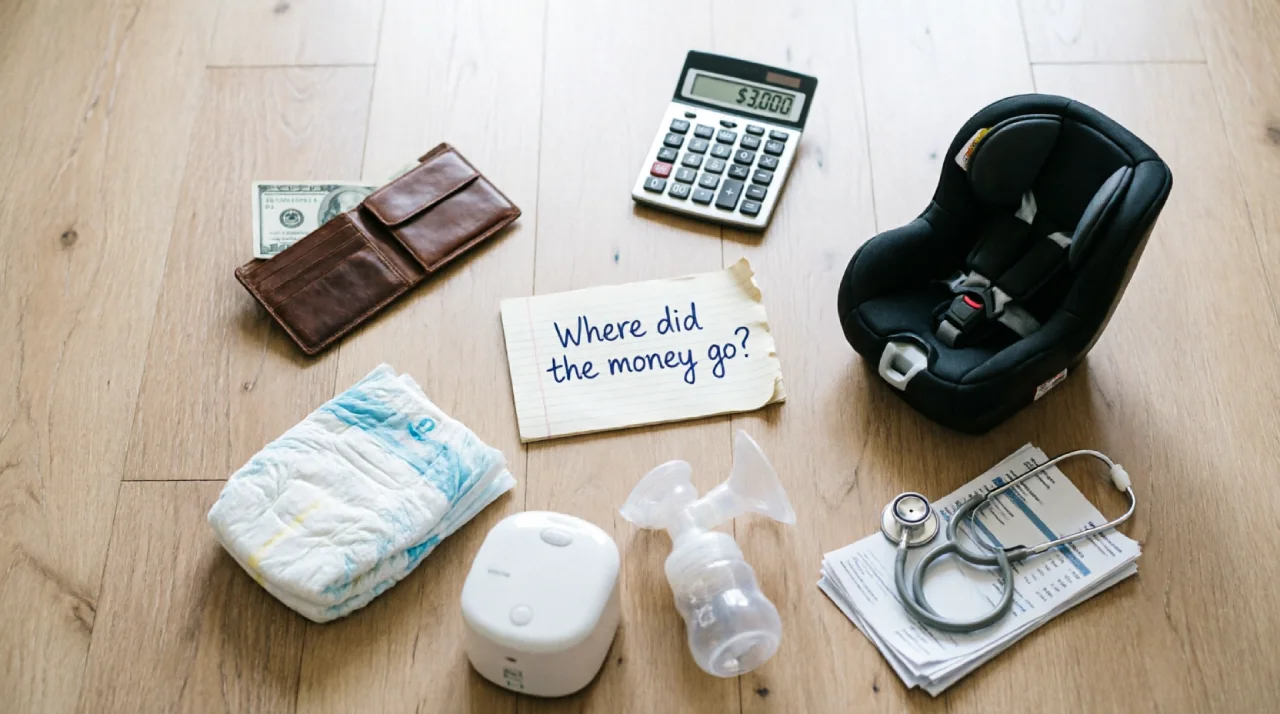
The ongoing costs are one thing. But the first year hits differently. It’s a concentrated blast of spending before you’ve even settled into a rhythm.
The Parental Leave Income Gap Many employers offer FMLA leave, which is unpaid. If one parent takes 12 weeks off without pay, that’s three months of lost income right at the moment your expenses are spiking. Even with short-term disability or partial paid leave, most families take an income hit. This is the hidden cost the $310,000 number completely ignores.
The Baby Gear Avalanche Here’s what you’re actually looking at in year one:
- Car seat: $150 to $400
- Crib and mattress: $200 to $800
- Stroller: $200 to over $1,000
- Diapers (monthly): $70 to $100
- Formula (monthly, if needed): $100 to $200
- First-year medical out-of-pocket: $1,000 to $3,000+
The first-year startup costs can easily reach $5,000 to $10,000 before the ongoing expenses even kick in. This catches people off guard because they’ve budgeted for “the baby” but haven’t itemized what the baby actually requires.
The Stuff You Don’t Think About Our electric bill went up noticeably because we were doing laundry constantly. We ordered takeout more often because we were too exhausted to cook. These micro-costs are invisible in the moment but real on the spreadsheet. Knowing they’re coming is half the battle.
Where Families Unknowingly Overspend: The Marketing Traps
Here’s something I learned the hard way: The parenting industry runs on fear. Fear that you’re not doing enough. Fear that cheaper means dangerous. Fear that the other parents in the Target checkout line are judging your cart. Fear that you don’t love your kid enough if you don’t buy the premium version of everything.
It’s all marketing. And it works because we’re tired and we care.
The Nursery Industrial Complex A $1,200 crib your baby will never remember versus a $150 IKEA crib that meets the exact same federal safety standards. Designer baby clothes worn for three weeks before being outgrown. The special changing table when a $30 changing pad strapped to a dresser works better and costs a fraction of the price.
The Gadget Graveyard Bottle warmers. Wipe warmers. App-connected baby monitors that track breathing patterns and send data to the cloud. Some of this technology is genuinely useful. Most of it solves problems you don’t actually have. Our wipe warmer went to Goodwill within two months.
The Premium Diaper Default Store-brand diapers from Costco, Target, or Walmart perform identically to premium brands in our experience—and cost about 40% less. We switched after a dad at daycare mentioned it. I ran the numbers once and never went back.
The New-Car Panic Try the car seat in your current vehicle before you visit a dealership. You might be surprised what fits. That $400 monthly car payment you avoid is massive.
Your baby needs a safe place to sleep, food, a car seat, and you. The rest is negotiable.
12 Painless Ways to Save $5,000+ Per Year: A Dad’s Field Manual
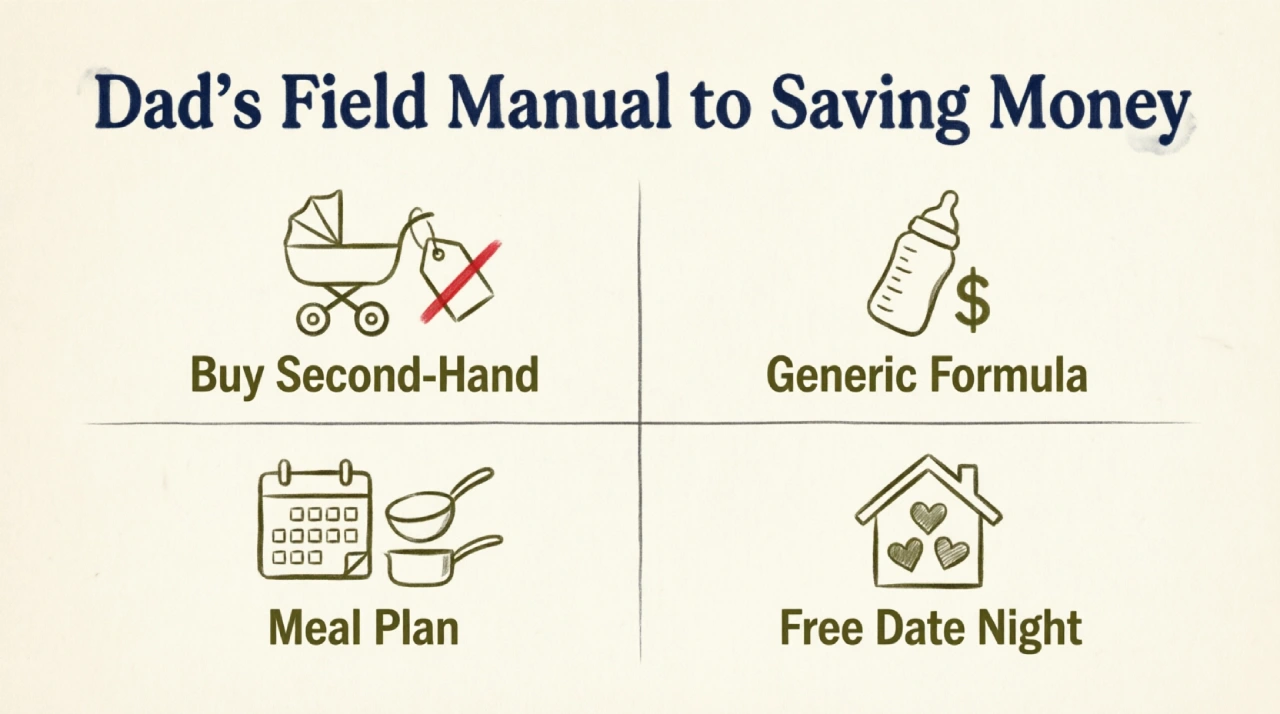
This is the section I needed at midnight that night. Not generic advice. Specific, tested, dollar-quantified strategies. Pick the ones that work for your situation.
1. Master the Second-Hand Market (Save $800-$1,500/year) Facebook Marketplace for strollers. Once Upon a Child for clothes. Kids outgrow things in weeks. Buying new means paying full price for something used for two months. We bought a $700 stroller for $150, and it was in perfect condition.
2. Switch to Store-Brand Diapers (Save $400-$600/year) Kirkland at Costco. Up & Up at Target. Parent’s Choice at Walmart. In our experience, they perform just as well as the premium brands and cost significantly less. Do the math once and you’ll never look back.
3. Use a Dependent Care FSA (Save $1,100-$2,000+/year in taxes) If your employer offers it, you can set aside up to $5,000 pre-tax for childcare expenses. Almost no one I talk to knows about this. I didn’t until our second kid. The money never hits your taxable income. Depending on your tax bracket, this can put over a thousand dollars back in your pocket.
4. Buy Generic Formula (Save $500-$800/year) All infant formula in the United States is FDA-regulated to the same nutritional standards. Store-brand formula is nutritionally equivalent to Enfamil and Similac. It costs roughly half as much. Our pediatrician confirmed this when we asked.
5. Test the Car Seat Before Buying a New Car (Save $3,000+/year in payments) Try installing a rear-facing car seat in your current vehicle before assuming you need something bigger. Many compact SUVs and sedans accommodate them just fine.
6. Audit Your Subscriptions (Save $300-$600/year) You’re too exhausted to watch all those streaming services right now. You haven’t been to the gym in months. Cancel what you’re not using and redirect that money.
7. Choose Term Life Insurance, Not Whole Life (Save $400-$800/year) You need life insurance now that you have a kid. You need term life—a policy that covers you for 20 or 30 years at a fixed, affordable rate. A good rule of thumb is 10-12 times your annual income. Whole life policies are dramatically more expensive and combine insurance with a mediocre investment product. Keep them separate.
8. The After-Bedtime Date Night (Save $1,200-$2,400/year) Date night with a sitter costs $60-$100 before you even leave the house. After bedtime, cook a nice meal together. Light a candle. Talk about something other than the baby. It’s better for your marriage and costs nothing.
9. Stick to Generic Medications (Save $100-$200/year) Infant Tylenol and generic acetaminophen are the same thing. Same active ingredient. Same dosing. Half the price. This applies to basically every over-the-counter children’s medication.
10. Join a Buy Nothing Group (Save $300-$500/year) Local Facebook groups where neighbors give away kids’ items for free. Toys, clothes, books, sometimes furniture. We got a bag of 30 pieces of toddler clothing for nothing because someone’s kid had outgrown them all in a month.
11. Meal Plan to Prevent Takeout Creep (Save $600-$1,200/year) The exhaustion-takeout cycle is expensive. $40 for emergency pizza adds up. A simple meal plan—nothing fancy, just knowing what you’re eating each night—prevents the last-minute delivery order. For us, it cut our takeout spending by about $150 a month.
12. Claim the Child Tax Credit (Don’t Leave Money on the Table) For 2025, the Child Tax Credit is worth up to $2,000 per qualifying child. Understand what you’re eligible for and claim it. This isn’t a savings tip. It’s a reminder not to miss free money.
Your Mileage Will Vary: Cost by State and Lifestyle
The national average is useful for headlines. It’s terrible for planning your actual life.
The single biggest variable is childcare. In Mississippi, full-time infant care might cost around $500 per month. In Massachusetts, it can exceed $2,000. That one line item explains nearly all the geographic variation in what it costs to raise a child.
The second-biggest variable is your support network. Grandparents nearby who can watch the baby one or two days a week? Your childcare costs drop immediately. On your own? The full weight of that expense falls on you. Even within the same state, costs swing dramatically between urban and rural areas.
Here’s my best advice: Stop reading national averages. Bookmark the MIT Living Wage Calculator for your state. Find the childcare line. That one number will tell you more about your real situation than any national study.
If you’re a single dad, the math looks different from everything above. But the saving strategies still apply. Every dollar you save on diapers, subscriptions, and unnecessary gear is a dollar back in your household.
Frequently Asked Questions
What is the average cost of raising a child per month in 2025? Based on the national average of $310,000 over 18 years, the monthly cost is approximately $1,400. This varies significantly by location, with some states averaging under $1,200 per month and others exceeding $2,500.
What is the most expensive age to raise a child? The first year is the most concentrated due to startup costs like gear, medical bills, and potential parental leave income loss. For ongoing expenses, the infant and toddler years are typically most expensive due to full-time childcare costs. Costs often decrease once children enter public school.
How much should I save before having a baby? Aim to have a dedicated baby fund of $5,000-$10,000 to cover first-year startup costs before the baby arrives. This covers the car seat, crib, stroller, initial medical expenses, and provides a buffer for the parental leave income gap.
Is it really $310,000 to raise a kid? The $310,000 figure is a national average from SmartAsset’s 2025 analysis of MIT Living Wage data for a two-parent, two-child household. Your actual cost will vary dramatically based on where you live, your childcare choices, and your lifestyle. Many families spend less. Some spend more. It’s a benchmark, not a bill.
How do families afford having kids? Most families afford kids through a combination of strategies: utilizing tax advantages like the Dependent Care FSA and Child Tax Credit, buying second-hand gear, choosing affordable childcare arrangements, and adjusting spending in other categories. Very few families have the full $310,000 saved upfront. They manage it month by month, just like other major life expenses.
What is the biggest expense of raising a child? Housing is typically the largest category at 30-35% of total costs, driven by the need for more space and location decisions tied to school districts. Childcare is the second-largest and most immediately painful expense, often rivaling a mortgage payment during the early years.
What baby items are not worth buying new? Clothing, strollers, baby carriers, and nursery furniture are all excellent candidates for the second-hand market. Babies outgrow these items in weeks or months. Car seats are the one item most experts recommend buying new unless you can verify the used seat’s full history and it hasn’t been in an accident or expired.
The Bottom Line: You’ve Got This
That $310,000 number scared the hell out of me at midnight on a Tuesday. Now, two kids later, I can tell you: It’s a statistic, not a sentence.
Millions of families make this work. Most of them aren’t earning extraordinary incomes. They’re making the same small, smart decisions you’re about to start making.
Three things to remember: Know your startup costs, because year one is the financial bottleneck. Claim every tax advantage available to you, especially the Dependent Care FSA and Child Tax Credit. And question every purchase through the lens of need versus marketing.
Providing for your family isn’t about spending the most money. It’s about making decisions that protect your family’s future while still enjoying the present. You’re already doing the work by reading this.
If you do nothing else this week, start with these three things: Check if your employer offers a Dependent Care FSA. Switch to store-brand diapers. And test your car seat in your current vehicle before you visit a dealership. Those three moves alone could save your family thousands this year.

