
I still remember the total flashing on the register: $1,045. For one month of groceries. For two adults, a six-year-old, and a toddler. I was the one pushing the cart that month — my wife had asked me to take over food shopping while she handled a family health scare — and I’d apparently treated the supermarket like a personal scavenger hunt. A box of organic crackers here, a fancy cheese I didn’t have a plan for there. The result was a fridge full of half-used ingredients and a credit card bill that made me sweat.
If you’re trying to save money on groceries for your family and you’re not exactly a wizard in the kitchen, I get it. I can’t whip up a risotto. I don’t own a Dutch oven. But I do know how to run the numbers, and after a few months of trial and error (and one unforgettable bag of slimy spinach), I landed on a system that slashed our grocery spending by $415 a month. I call it Backwards Shopping, and in this article I’m going to walk you through the whole thing — store-brand experiments, a no-cook meal plan that even I can handle, and a printable list you can stick on the fridge today.
The Backwards Shopping Method: Flip Your Grocery Routine and Save

Before I figured this out, my shopping routine was chaos. I’d walk into the store with a blurry mental list, grab whatever looked convenient, and routinely blow the budget. The biggest surprise wasn’t the total — it was how much food we threw away.
Then I fell into a Reddit hole on r/Frugal and somebody said, “Shop your pantry first.” That was my lightbulb. I was shopping exactly backwards. Instead of starting with recipes or wandering aisles, I needed to start with what we already owned and work backwards to the store. That mindset shift changed everything.
Here’s the Backwards Shopping method in three simple steps:
Step 1: Audit your kitchen before you touch your keys. Open the fridge, freezer, and pantry. Write down every single thing that’s still edible — half a box of pasta, frozen ground beef, a bag of carrots, that can of black beans hiding in the corner. You’ll almost certainly find the start of three or four meals.
Step 2: Map 3-4 dirt-simple meals using those ingredients first. Don’t go hunting for elaborate recipes. Ask yourself, “What can I combine right now?” Pasta plus frozen vegetables plus a jar of sauce is a meal. It’s not Instagram-worthy, but it keeps you out of the grocery store.
Step 3: Build your shopping list from the gaps. You only buy the items you need to complete those meals, plus a handful of staple fillers like milk, bread, and fruit. The list becomes surprisingly short, and you walk into the store with a mission instead of a fog.
Immediately, two things happened. My impulse buying cratered because I wasn’t wandering the aisles dreaming up hypothetical dinners. And our food waste plummeted. I used to throw out wilted produce and mystery leftovers every week; now I shop to fill holes, not to add to the chaos.
Store Brand vs. Name Brand: My Real-World Price Showdown
Once I had the Backwards Shopping habit locked in, I tackled the next uncomfortable truth: I was a name-brand snob. I assumed store brands were sad imitations, and I was nervous my kids would mutiny if I swapped their favorite cereal.
So I did what any spreadsheet-loving dad would do: I ran the numbers and a blind taste test. I took a typical week’s grocery list and compared name-brand prices to Walmart’s Great Value and a few Aldi staples. Here’s what I found on a real shopping trip in March:
| Item | Name Brand (Price) | Store Brand (Price) | Savings |
|---|---|---|---|
| Peanut Butter (16 oz) | Jif – $4.48 | Great Value – $2.24 | $2.24 |
| Pasta Sauce (24 oz) | Prego – $3.18 | Great Value – $1.48 | $1.70 |
| Cheddar Cheese Block (8 oz) | Tillamook – $4.98 | Great Value – $2.22 | $2.76 |
| Quick Oats (18 oz) | Quaker – $4.12 | Great Value – $2.48 | $1.64 |
| Canned Black Beans (15 oz) | Bush’s – $1.58 | Great Value – $0.72 | $0.86 |
| Yogurt Cups (4-pack) | Yoplait – $3.98 | Great Value – $2.18 | $1.80 |
| Bread (loaf) | Nature’s Own – $3.98 | Aldi L’oven Fresh – $1.29 | $2.69 |
| Tortilla Chips (13 oz) | Tostitos – $4.98 | Aldi Clancy’s – $1.95 | $3.03 |
| Canned Tuna (5 oz) | Bumble Bee – $1.48 | Great Value – $0.88 | $0.60 |
| Shredded Mozzarella (8 oz) | Kraft – $4.48 | Great Value – $2.28 | $2.20 |
| Total (10 items) | $38.24 | $17.72 | $20.52 |
In one week, simply switching these 10 items to store brands saved me over $20. Over a month, that’s $80-$100 staying in our pockets — and I hadn’t changed what we ate, just whose label was on the package.
The taste test sealed the deal. My six-year-old declared the store-brand mac and cheese “more cheesier.” My wife couldn’t tell which pasta sauce was which. The only rebellion came when I swapped the ketchup — apparently that’s sacred. So I kept the name-brand ketchup and swapped everything else. I later learned Consumer Reports has found the same thing for years: many store brands match or beat the big names. My kitchen just proved it for our own dinner table.
Meal Planning for Dads Who Can’t Cook (The Assembly Meal Matrix)
Now I had cheap ingredients. Problem was, I didn’t know what to do with them without setting off the smoke alarm. Every meal planning article I found assumed I could cook — twelve-step recipes, strange spices, and phrases like “deglaze the pan” that made me close the browser.
I needed an Assembly Meal Matrix: a dead-simple list of no-cook or minimal-cook meals using cheap staples I can always keep around. No recipes, just combining. If you can open a can, tear open a bag of salad, or use a microwave, you’re qualified. Here are ten meals that have saved our weeknights and our budget:
- Rotisserie chicken + bagged Caesar salad kit + flour tortillas = chicken wraps (serves 4, ~$9)
- Canned black beans + instant rice + salsa + shredded cheese = burrito bowls (~$7)
- Canned tuna + microwave pasta cups + frozen peas + a little mayo = tuna pasta salad (~$6)
- Deli turkey + cheese slices + sandwich buns + baby carrots = grown-up lunchables (~$8)
- Bagged coleslaw mix + rotisserie chicken + Asian dressing = crunchy chicken salad (~$8)
- Refried beans + tortillas + pre-shredded cheese = bean and cheese quesadillas (~$5)
- Hard-boiled eggs (buy them pre-made) + toast + apple slices = breakfast-for-dinner (~$5)
- Frozen meatballs + jarred marinara + sub rolls + provolone = meatball subs (~$10)
- Canned chili + corn chips + shredded lettuce + chopped tomato = walking taco bowls (~$8)
- Ramen noodles + frozen stir-fry veggies + a handful of rotisserie chicken = 10-minute noodle bowls (~$6)
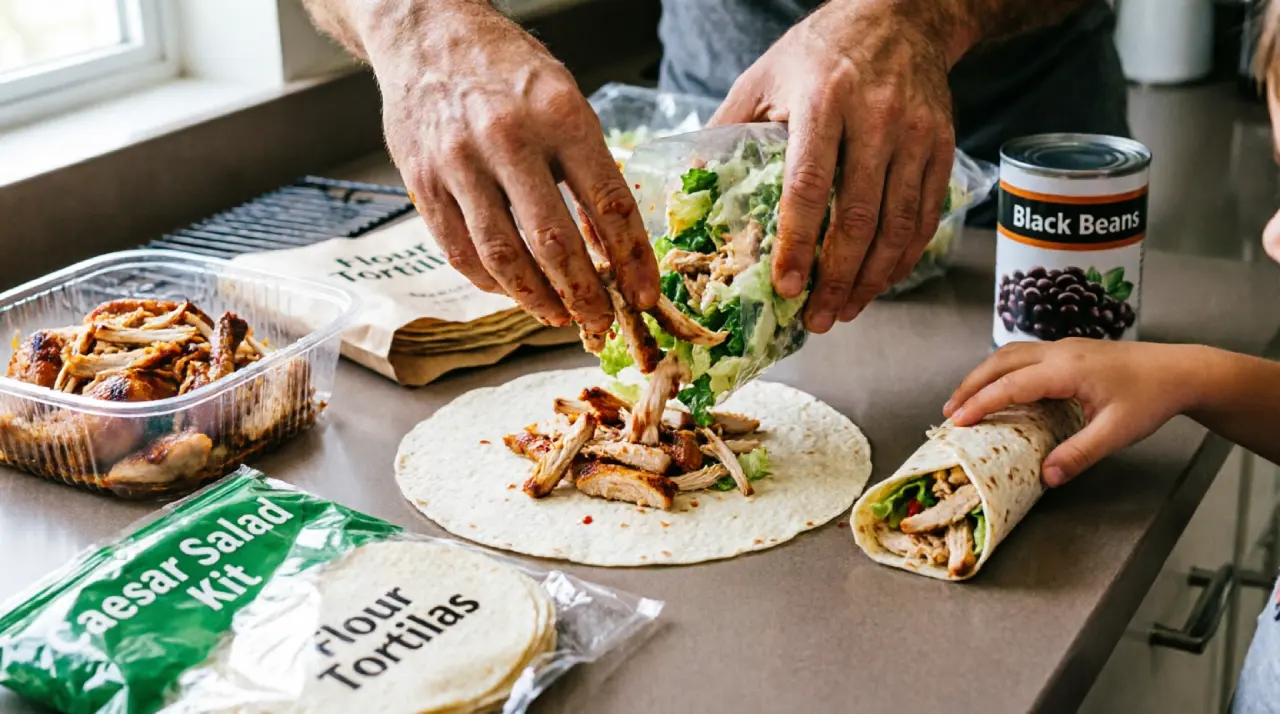
I keep this matrix taped inside a cabinet. On nights when I’m too tired to think, I scan it, grab three things, and dinner is on the table in under ten minutes. It kills the 5 p.m. “what’s for dinner?” panic and, more importantly, stops me from ordering $40 of takeout. You don’t need to be a chef to feed your family cheaply. You just need a matrix and a little confidence.
Bulk-Buying Traps I Fell Into (And What Actually Saves You Money)
I used to think buying in bulk was the ultimate dad money move. Bigger package, better price, right? Then I threw away a $43 bag of organic spinach that turned to green sludge before we could touch it. I found a hidden pantry corner where three boxes of quinoa had been collecting dust since 2022. Bulk buying without a plan is just expensive garbage.
Here are the three traps I fell into and the rule that fixed it:
- Trap 1: Perishables in massive quantities. That jumbo tub of spring mix might be a great deal per ounce, but if your family eats salad twice a week, you’re racing the clock. I now only buy bulk produce if it can be frozen or has a long shelf life — potatoes, onions, apples, or frozen vegetables.
- Trap 2: Variety packs your family won’t actually eat. I bought a 36-count yogurt variety pack to “save money.” My kids ate the strawberry, left the plain and key lime to die. I was paying for garbage. Stick to flavors and products your family already demolishes.
- Trap 3: Aspirational health food stockpiles. The quinoa, the chia seeds, the canned jackfruit I’d read about on a health blog — all bought in bulk, all abandoned. Now I only bulk-buy staples we use every single week.
What I actually stock up on now: Rice, canned beans and tomatoes, peanut butter and jelly, pasta and jarred sauce, frozen veggies and frozen fruit, toilet paper, and shredded cheese (it freezes perfectly). The rule I now follow: if I can’t name the exact meal I’ll use it in this week, I don’t buy the giant size. The USDA estimates that 30-40% of the food supply goes to waste, and I was definitely doing my part before I got smart about bulk.
Your Printable Backwards Shopping List + Inflation-Proofing
After a few months of this system, I created a one-page printable grocery list that follows the Backwards Shopping flow. It has sections for your pantry audit, your fridge/freezer check, your assembly meal picks (with a mini matrix right on it), and a gap shopping list. You fill it out in five minutes before you leave the house, and you walk into the store with a brain instead of a hurricane.
Grab the printable version below and stick it on the fridge. No email required — just print it and go. I made it because the hardest part for me was remembering the method in the middle of a chaotic Saturday supermarket run with two kids yelling about cereal. This list keeps me honest.
A quick word on inflation: We all feel it, and prices will probably keep climbing. The beauty of this system is that it doesn’t rely on coupon clipping or chasing sales flyers. It’s a behavioral method. When egg prices spiked earlier this year, I just swapped eggs in the breakfast-for-dinner slot for canned beans — the matrix bent but didn’t break. Backwards Shopping works whether eggs are $2 or $6 because it forces you to use what you have and fill only the real gaps. No panic, no waste, just a steady, predictable grocery budget.
Frequently Asked Questions
How can I feed a family of 4 on $100 a week? Start with the Backwards Shopping method to eliminate waste, switch to store brands on staples (saving $20+ a week), and lean on the Assembly Meal Matrix to avoid takeout. With these three changes, many families can get close to or under that $100 mark without feeling deprived.
What are the cheapest nutritious foods for families? Canned beans, lentils, brown rice, oats, frozen vegetables, eggs, peanut butter, canned tuna, whole chickens (rotisserie is a godsend), and seasonal fresh fruit. These are the backbone of the meal matrix and all cost pennies per serving.
Does buying in bulk really save money? Only for non-perishable or freezer-friendly items you use constantly. Bulk buying fresh produce or novelty items without a plan almost always leads to food waste, which cancels out any savings.
Is Walmart or Aldi cheaper for a family grocery budget? Both are consistently cheaper than traditional supermarkets. In my experience, Aldi wins on basics like bread, dairy, and snacks; Walmart’s Great Value line has an enormous variety and slightly lower prices on pantry staples like peanut butter and beans. I use both depending on the week.
How do I stop impulse buying at the grocery store? Shop backwards. When you audit your kitchen first and build a tight list from the gaps, you walk into the store with a mission. I also never shop hungry and never bring kids if I can avoid it — but the list is the real shield.
What is the best grocery budget for a family of 4? The USDA’s Thrifty Food Plan for a family of four (two adults and two kids) averages around $975 per month. Many families overspend by $300-$500 simply due to waste and brand-name habits. Our own budget dropped from $1,045 to $630.
Can this system work if someone in the family has dietary restrictions? Absolutely. The Backwards Shopping method is simply a framework. Swap in gluten-free tortillas, dairy-free cheese, or whatever your household needs. The meal matrix is flexible by design — just replace ingredients with your safe alternatives.
You’ve Got This, Dad
When I added up the changes — the Backwards Shopping method, the store-brand swaps, the Assembly Meal Matrix, and the end of dumb bulk buying — our monthly grocery spend dropped from $1,045 to $630. That’s $415 back in our account every single month, or nearly $5,000 a year. It all started with one backwards trip to my own pantry.
I’m not a financial guru, and I still can’t make a decent omelet. But I know this system works for a tired dad who just wants to feed his family without burning money. Print the list, try the matrix for a week, and see what happens after your first backwards shopping trip. You might be as surprised as I was.
If you’re rethinking your whole family budget app, check out our other money articles on Daddy Magazine — we’ve got real-dad takes on everything from emergency funds to side hustles. Now go own that grocery bill.

